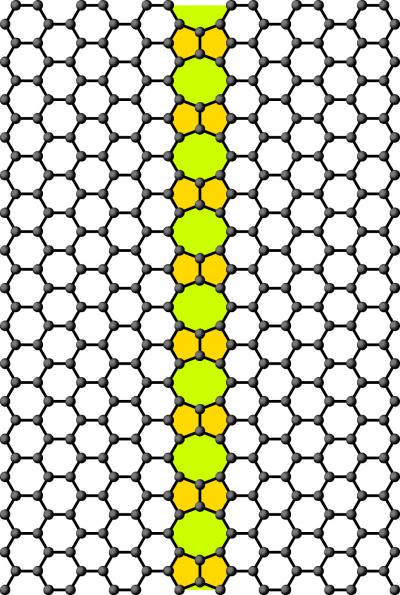
"The ability to image surfaces with atomic-scale resolution in the 1980s ushered in the nanotechnology era. From the beginning, it was understood that although scanning tunneling microscopy (STM) could resolve distances between individual atoms on surfaces, what the images really showed were spatial variations in the electronic density of states of the surface near the Fermi level"
Textures and backgrounds for your next project, and articles about visual patterns in nature, arts and science, with patterns on clothing, porcelain, rugs, wallpaper, stationary and gifts.
Showing posts with label crystals. Show all posts
Friday, May 6, 2011
Physics: atomic-scale surface imaging ushered nanotechnology: physics.aps.org
Physics - Proper carbon ID required:
Thursday, May 5, 2011
Valleytronics one step closer to reality | e! Science News
NRL researchers take a step toward valleytronics | e! Science News:
The valley degree of freedom in graphene gained attention in 2007 when it was proposed that electrons and holes could be filtered according to which valley they occupy. Unfortunately, the structures required for this and subsequent valley filters are difficult to fabricate, and as a result a valley filter has yet to be demonstrated experimentally
"Valley refers to energy depressions in the band structure, which describes the energies of electron waves allowed by the symmetry of the crystal."
Related articles
- Electron Band Structure In Germanium, My Ass (pages.cs.wisc.edu)
- Less is More: Researchers Pinpoint Graphene's Varying Conductivity Levels (nextbigfuture.com)
- Epitaxial silicene formed on single-crystalline ZrB2 thin Films: structure and electronic properties (nextbigfuture.com)
- Nokia's Morph nanotechnology concept device to benefit from ... (graphenetimes.com)
- FOR KIDS: Busy bacteria leave big mark (sciencenews.org)
Liquid crystals: cholesteric blue - Discovery of new ordered structures (nanoweek.com)
Discovery of new ordered structures of a liquid crystal:
"Liquid crystals are widely used in various devices including TV displays and cellular phone displays due to their unique optical properties that can be easily controled. Most of such devices utilize the change in the optical properties of a nematic phase (a phase of liquid crystals in which molecules align in one direction) by applying an electric field. Recently, different types of ordered phases of liquid crystals referred to as cholesteric blue phases"
Related articles
- Boffins develop liquid crystal solid-state raygun turret (go.theregister.com)
- Laser steering system uses liquid crystal to destroy the enemy on the cheap (video) (engadget.com)
- New method for self-assembling molecules (nextbigfuture.com)
- The Future of OLED TV (nextbigfuture.com)
- Nanotubes coming to a screen near you (sciencenews.org)
- CNT enabled transistor targets OLED displays (nanotechweb.org)
- Novelties: Have You Charged Your Eyeglasses Today? (nytimes.com)
Friday, March 25, 2011
Honeycomb crystalline structure & quantum dots
Silicene: It Could Be The New Graphene - Science News:

"Speaking March 24 at a meeting in Dallas of the American Physical Society, Fleurence described a new recipe for making silicene. He and his Japanese colleagues grew a thin layer of silicon on top of the ceramic material zirconium diboride. X-rays shined on this thin layer of silicon revealed a honeycomb of hexagons similar to the structure of graphene."
Related articles
- Breakthrough in growth of carbon nanotubes at temperature compatible with CMOS (nextbigfuture.com)
- Molybdenite outshines silicon and graphene for electronic applications (gizmag.com)
- Creating quantum dots from buckyballs (nanotechweb.org)
Subscribe to:
Posts (Atom)